
Italy Eyes Schengen Halt Over Ceuta Migrant Influx as Spain Rejects Emergency
CEUTA, Spain / ROME, Italy — A severe migratory crisis in the Spanish autonomous city of Ceuta has reached a critical juncture, prompting the Italian government to consider suspending the Schengen Agreement with Spain. The situation has left local authorities overwhelmed, while the Spanish central government has firmly rejected requests to declare a national emergency to manage the influx.
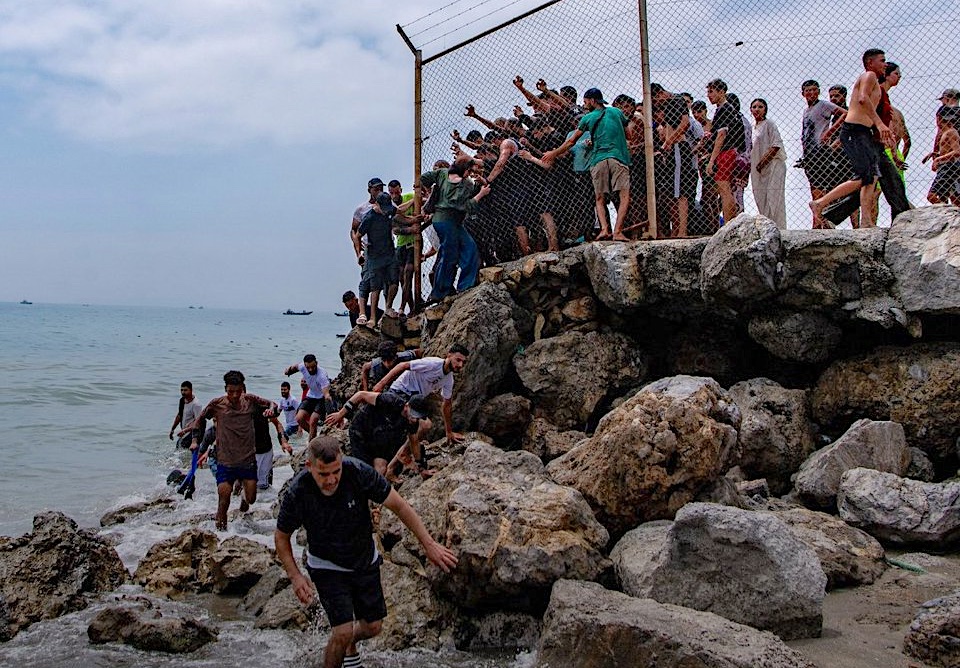
Almost 9000 migrants swim into Spain in a single day
The surge in irregular border crossings peaked on Thursday, with estimates of the arrivals varying significantly depending on the source. While the Spanish Civil Guard initially reported over 5,000 entries in a 24-hour period, Moroccan state television and early local police estimates suggested the number could range between 20,000 and 30,000. The vast majority of those crossing were young men, with very few women observed among the groups. The sheer volume of arrivals has profoundly disrupted daily life in the enclave, which has a registered population of under 85,000. Local businesses, supermarkets, and major retailers have shuttered their doors, and residential windows remain tightly closed as large groups of migrants navigate the streets, particularly in the border-adjacent neighborhood of El Príncipe.
INSANE FOOTAGE: Thousands of migrants continue crossing from Morocco into Spain’s Ceuta enclave, as local officials reportedly urge Madrid to declare a national emergency. pic.twitter.com/dlbbKOjBV1
— Breaking911 (@Breaking911) July 30, 2026
The dramatic increase in crossings has been linked to recent legal and political developments in Spain. Some migrants were recorded shouting praises for Spanish Prime Minister Pedro Sánchez as they entered the territory. This enthusiasm is widely attributed by observers to the Spanish government’s ongoing regularization initiatives and a recent Supreme Court ruling which determined that immediate “hot returns” cannot be legally applied to individuals who enter Spanish territory by swimming across the border into Ceuta or Melilla.
In response to the escalating crisis, Ceuta’s President, Juan Jesús Vivas, urgently requested that the central government declare a “national emergency” to unlock additional resources and coordinate a unified, forceful response. However, the Spanish Ministry of the Interior formally rejected the request on Thursday morning. The ministry clarified that under current Spanish law, a national emergency declaration is strictly reserved for natural or technological disasters, and cannot be legally activated to manage migratory flows. Consequently, local National Police and Civil Guard units remain stretched to their limits, managing the situation without the requested extraordinary reinforcements.
The developments in Ceuta have rapidly escalated into a matter of international concern, drawing a sharp response from Rome. Italian Prime Minister Giorgia Meloni has announced that her government is actively evaluating the temporary suspension of the Schengen border-free travel agreement with Spain. Following an emergency meeting with Italian Interior Minister Matteo Piantedosi, Meloni stated that the scenes emerging from Ceuta demonstrate that uncontrolled clandestine immigration poses a concrete threat to European border security.
Emphasizing that Italy will not remain passive, the Italian government indicated it is prepared to deploy extraordinary measures to defend its borders and ensure citizen security if the situation continues to destabilize the region. The potential suspension of Schengen protocols would represent a significant diplomatic and logistical rupture, highlighting the profound strain the current migratory pressure is placing on European unity and cooperation.
Several Policemen Get Acid Burns as Moroccan Migrants Storm Spain’s Border
As the situation remains highly volatile, Spanish authorities are continuing to process the arrivals while grappling with saturated reception facilities and limited manpower.
-Thailand News (TN)